
[Full Homily by Rt. Rev. Peter Adrian Chifukwa, Bishop of Dedza and Vice President of MCCB | 3rd October 2026]
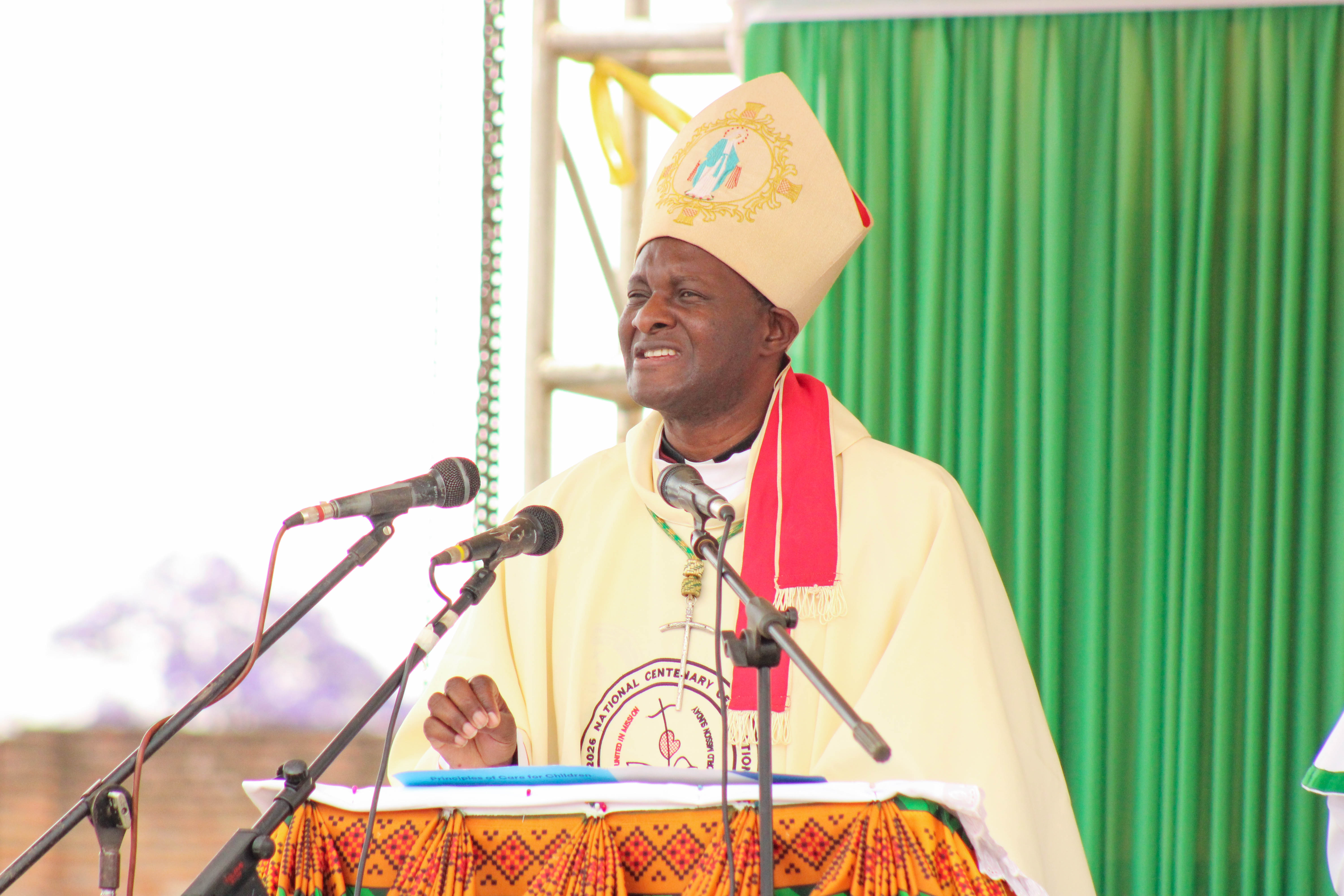
My brothers and sisters, we have one duty to do during this Eucharistic celebration: to ask ourselves a question. When we return home, what message are we carrying home to nourish us in our everyday lives? Or we can say, how are we going to judge the success of this celebration today?
Think about Christians who are coming in the next century. When celebrating 200 years of World Mission Sunday, how are we going to judge that this celebration assisted us in that 100-year period constituting the 200 years of World Mission Sunday?
Therefore, I think the readings we are going to reflect on could possibly be the marks of our growth and the growth of the Church in Malawi.
First, today’s celebration is not a celebration of history or the first event when Pope Pius XI instituted World Mission Sunday, but it is a celebration about our life as Christians, a renewed and ancient call to our missionary responsibility as Christians. So, we are looking to the future with the hope that we are going to grow the Church.
In the first reading, Isaiah reminded the Israelites that God chose them to be the light to the world, and certainly the same message goes to us today. We are the light of the world, and definitely Jesus Christ is commissioning us today to be that light of the world.
I think that’s the message that we need to carry. We are going out as the light of the world. But perhaps a second question would help us to reflect more about being the light of the world, and the question would be: What impact do we want to see in ourselves? What impact do we want to see in the Church? What impact do we want to see in society to show that we are the light of the world?
So, we reflect about the possible marks that would indicate our growth.
Firstly, the theme of today is “One in Christ and United in the Mission.” You know, the theme echoes the priestly prayer of Jesus. In John 17:20–23, he prayed that all Christians may be one, and we must preserve that unity.
So, today’s celebration is urging us to preserve that unity of all of us who believe in Christ. Since we are all one, then the Church belongs to all of us, so that we must not leave the missionary way only to priests, only to sisters, or only to bishops. The missionary way belongs to all of us because we are one in Christ.
Therefore, the successes of our mission and the shortcomings of the mission of the Church belong to all of us. If we have done well, we all thank God for his grace, which has enabled us to do great missionary work. But if something has not gone well, we all encourage one another to do well.
So, as we journey to the next 100 years, we journey as one, all of us having the same missionary responsibility to make sure that the Word of God is known throughout the world.
And the same motto, the same theme, “One in Christ, United in the Mission,” is also affording us another inspiration that we must carry. Saint Paul is reminding us in the second reading that there is no difference between a Jew and a Gentile.
In the early Christian communities, non-Jews or Gentiles were not being fully accepted as Christians. So, Saint Paul was warning this Christian community against the influence of temporal realities of being a Jew or a Gentile that would impede the missionary way. So, if an individual believes, definitely one belongs to Christ, to the Word of Christ. So, nobody should be a stranger in that Word of Christ.
The temporal reality of the Church in Malawi is that we members belong to different ethnic groups, genders, academic backgrounds, and economic advantages or disadvantages. These temporal realities can lead us into a mentality that some of us, the faithful, are more important than others and, therefore, the more important ones should do more, while the less important ones should do less.
Saint Paul reminds us that we are all one, and each one of us is needed in the mission. We are all the salt of the world. Certainly, as the salt of the world, we must bring the Gospel to our weak places, to our villages, to our schools, to public institutions and definitely the wider society will be much, much affected positively.
Saint Paul is addressing our current background, that sometimes in certain areas that everybody has to enjoy, we are usually confronted by these ethnic realities, whereby sometimes we see employment being determined by ethnic realities and appointments being determined by ethnic realities.
So, we want to see a society that is different from that, and who are going to influence that? We are the missionaries because we bring that missionary spirit to our weak places.
Another mark that is very important for us to judge within the Church in Malawi over the next 100 years, whether or not we are seen to have grown, will be the way we look at the pastoral structures in the parishes and dioceses.
Sometimes we understand these pastoral structures to be an exhaustive way of proclaiming the Word of God, that these structures contain everything that there is so that we preach the Word of God. This is a misleading mentality.
As missionaries, we must not remain satisfied that there are no further means to proclaim the faith. We are invited as missionaries to discern new ways of evangelization and pastoral care beyond the current pastoral structures.
For instance, in the contemporary world today, there are more spaces being born, digital spaces being born, and definitely, as a Church, we underutilize these digital spaces. These are the spaces where we can access the faithful struggling with their faith and conscience. We are to access these Christians so that we may awaken their faith, and definitely an attitude of inward-looking must be discouraged so that we reach every space where we are needed to preach the Gospel.
For instance, we have so many structures like the small Christian communities, the parish movements, and we have the parish as a pastoral structure. But perhaps today we are invited that small Christian communities should no longer remain small Christian communities, but missionary small Christian communities.
The movements in the Church should no longer remain just mere movements, but missionary movements. A parish should remain a missionary parish. The religious should remain not only religious, but missionary religious. They are going out to preach the Good News.
As we journey towards the next 100 years of our evangelization, perhaps another mark that will determine whether or not the Church has grown is not only the population. Definitely, the population will have grown, but that will not be enough for us to determine that the Church in Malawi has grown.
Because today we have celebrated this centenary celebration for World Mission Sunday, perhaps a change of mentality from excessive dependence on overseas financial assistance would be another area for us to determine that we are really growing.
Since the Church in Malawi is regarded as a mission territory, meaning that it is a Church that is experiencing limited resources before so many serious needs to proclaim the Good News.
However, we are grateful that we have benefited from the collections of World Mission Sunday for many, many years through subsidies to our dioceses, subsidies for the formation of priests, sisters, catechists and other lay leaders, and also in practical needs like building and maintaining churches, building schools, providing bursaries, building convents, priests’ houses and health centres.
This is the visibility of the impact of World Mission Sunday on our Church in Malawi, because we have been supported. But perhaps, as we are able to see, this foreign assistance is dwindling. Therefore, we have to bear what is lacking in having enough resources to preach the Good News.
So, each one of us is invited to be more generous in order to make sure that the Church has enough resources to preach the Good News. Everybody, even those people who think they have limited resources, is invited to contribute what he or she can so that the Church may maintain its missionary work to preach the Good News, because the Church requires the resources to preach.
If we had no subsidies coming from overseas, the Malawian Church could have had a very different face and could have been very behind in many ways.
So, today this celebration is reminding us that we have to be generous towards mobilizing resources for the Church. We must be very creative in how we can mobilize these resources for the Church. Generosity is a noble service to the Gospel.
In the conclusion of our reflection, we have reflected that through the two readings, really, Christ depends on us for his Gospel to be spread to the whole world.
And we have identified very few marks of judging our growth as Christians and the Church in Malawi. So, today is a celebration to start a new journey for the Church in Malawi and for each one of us, that we are becoming more missionary.
Today we have a new name. We are now missionaries.
So, if you are a parent, you are not only merely a parent, but you must be a missionary parent, so that the children growing from that family will also be missionaries.
If we are priests, we are not only merely priests, but we are missionary priests. If we are sisters or brothers, we are not merely brothers and sisters; we are missionary sisters and missionary brothers.
If we are catechists, we are not merely catechists, but we must be missionary catechists, because there is a difference between simply saying a catechist and a missionary catechist, and that difference is our journey to establish in the next 100 years.
We are coming from parishes, and certainly today we are saying they are no longer merely parishes, but they are missionary parishes.
If you are a student, you are now a missionary student. If you have friends or you are a friend, you are now a missionary friend.
This is the message that we need to carry for the next 100 years, which our fellow Christians in the next 100 years should use to judge whether or not the Church in Malawi and each one of us as an individual has grown.
May we continue to pray for the Church in Malawi, that it may embrace this change in its journey, and for each one of us to receive the grace to be more missionary.
Thank you.